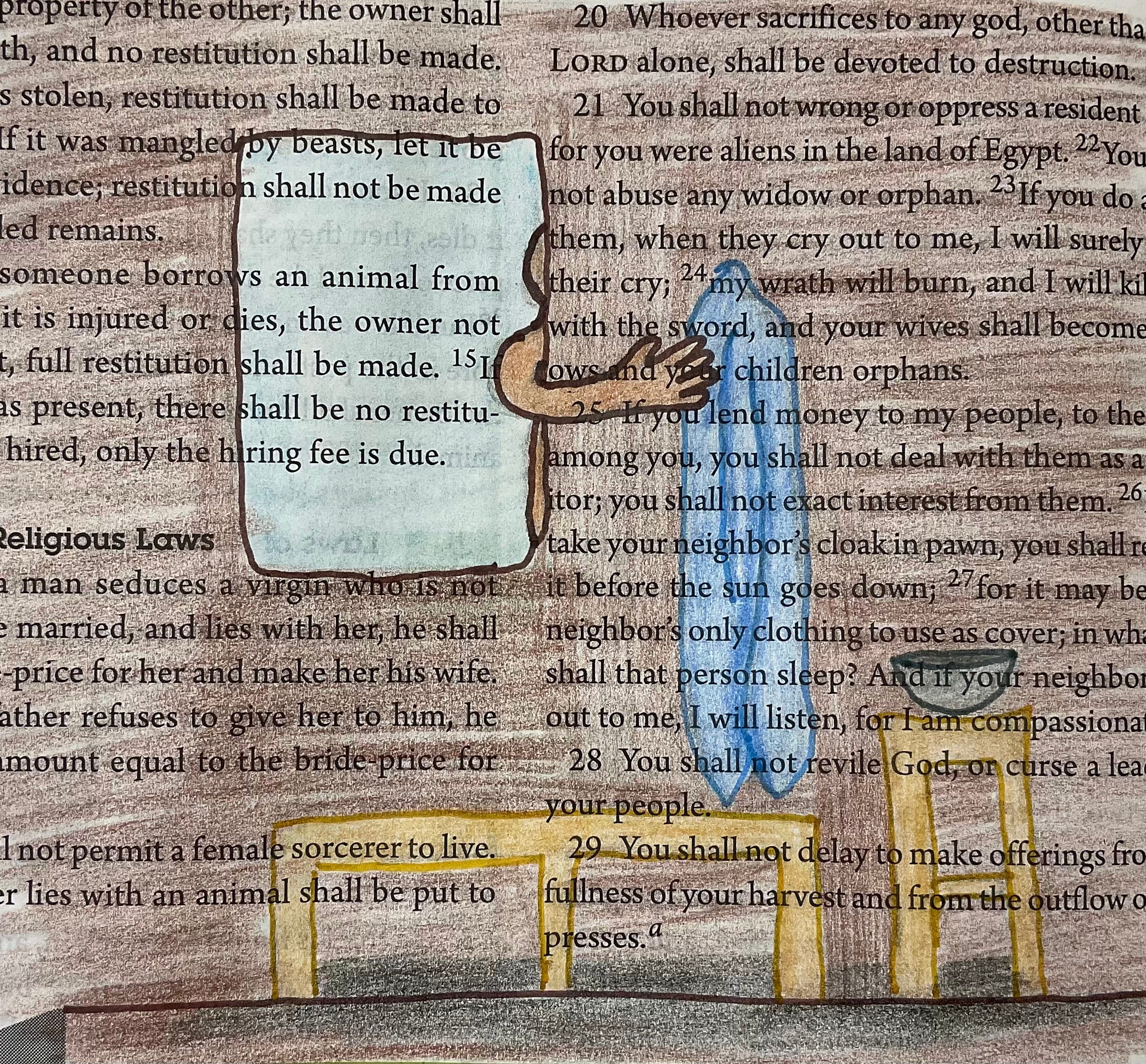
Chapter 22 continues laying out laws for the Israelites for specific instances. Though these laws go with the people and their understanding of the Commandments, these laws were probably not created for the people at the time of their sojourn at Mount Sinai. These laws were written for a more settled time in Israelite history, as some of these laws pertain to fields of grain and vineyards. Vineyards take a while to cultivate. These laws tell us so much about the kinds of issues and the social norms of the when they were codified. Don’t worry, the story will pick up again in another chapter.
Sadly, the way the laws about stealing are written, they assume that people will steal. Even though it is against the Ten Commandments. They say ‘when’ not ‘if’. When someone steals an ox or a sheep and slaughters or sells it, the thief shall pay five oxen for an ox and four sheep for a sheep. The thief shall make restitution but if unable to do so, shall be sold for the theft. More slavery! Typically when people steal things, they cannot obtain them in normal ways. So this probably happened more frequently than restitution. When the animal, whether ox or donkey or sheep is found alive in the thief’s possession, the thief shall pay double.
If a thief is found breaking in, and is beaten to death, no bloodguilt is incurred, but if it happens after sunrise, bloodguilt is incurred. I wonder if this difference is in recognition that it is harder to see how badly you’re beating someone in the dark.
When someone causes a field or vineyard to be grazed over, or lets livestock loose to graze in someone else’s field, restitution shall be made from the best in the owner’s field or vineyard.
When fire breaks out and catches in thorns so that the stacked grain or the standing grain or the field is consumed, the one who started the fire shall make full restitution.
When someone delivers to a neighbor money or goods for safekeeping, and they are stolen from the neighbor’s house, then the thief, if caught, shall pay double. If the thief is not caught, the owner of the house shall be brought before God or the judges, to determine whether or not the owner had laid hands on the neighbor’s goods. In any case of disputed ownership involving ox, donkey, sheep, clothing, or any other loss, of which one party says, “This is mine,” the case of both parties shall come before God (or the judges), the one whom God condemns shall pay double to the other. These laws make use of the new judge system among the Israelites.
When someone delivers to another a donkey, ox, sheep, or any animal for safekeeping, and it dies or is injured or is carried off, without anyone seeing it, an oath before the Lord shall decide between the two of them that the one has not laid hands on the property of the other, the owner shall accept the oath, and no restitution shall be made. But if it was stolen, restitution shall be made to its owner. If it was mangled by beasts, let it be brought as evidence, restitution shall not be made for the mangled remains. When someone borrows an animal from another and it is injured or dies, the owner not being present, full restitution shall be made. If the owner was present there shall be no restitution, if it was hired, only the hiring fee is due.
When a man seduces a virgin who is not engaged to be married, and lies with her, he shall give the bride-price for her and make her his wife. But if her father refuses to give her to him, he shall pay an amount equal to the bride-price for virgins. I wonder how often someone would refuse in this case, given that women were valued for their purity and their ability to bear children.
You shall not permit a female sorcerer to live. I wonder what the back story for this law is.
Whoever lies with an animal shall be put to death. This kind of behavior has been illegal in many cultures for thousands of years.
Whoever sacrifices to any god, other than the Lord alone, shall be devoted to destruction. This law specifically backs up the first of the Ten Commandments, but the outcome is interestingly stated. It is more commentary than punishment. Unless it means something we lose in translation.
You shall not wrong or oppress a resident alien, for you were aliens in the land of Egypt. You shall not abuse any widow or orphan. If you do abuse them, when they cry out to me, I will surely heed their cry, my wrath will burn, and I will kill you with the sword, and your wives shall become widows and your children orphans. This is the first statement of God’s partiality towards widows and orphans and this becomes a reoccurring theme throughout the scriptures.
If you lend money to my people, to the poor among you, you shall not deal with them as a creditor, you shall not exact interest from them. This law becomes a big deal later in history.
If you take your neighbor’s cloak in pawn, you shall restore it before the sun goes down; for it may be your neighbor’s only clothing to use as cover, in what else shall that person sleep? And if your neighbor cries out to me, I will listen, for I am compassionate. This I can see being a law from the migratory period of the Israelite story.
You shall not revile God, or curse a leader of your people.
You shall not delay to make offerings from the fullness of your harvest and from the outflow of your presses. This law definitely pertains to the settled timeframe of Israelite history. Presses were made out of heavy stones, they did not transport easily. This is the beginning of the laws about giving one-tenth of all the harvests to God. This includes grains, and olive oil and grape juice or wine.
The firstborn of your sons you shall give to me. You shall do the same with your oxen and with your sheep: seven days it shall remain with its mother; on the eighth day you shall give it to me. You shall be people consecrated to me; therefore you shall not eat any meat that is mangled by beasts in the field; you shall throw it to the dogs. The understanding of what it meant for the firstborn to be given to God changed over time. Originally it was through sacrifice. Later it becomes dedication for the priestly family. This law does not give us much clue as to what it meant at the time, but we will see more of this later.
The Israelites lived a scarcity model of economics, which shows up in the way they created their laws and restitutions. The Egyptian society was based around the cycles and scarcity of the Nile, so it makes sense that they would be influenced in this direction.
Questions
Which law makes the most sense to you? Which makes the least sense to you?
What do these laws mean to you?
Have you ever read the laws of your local area or country? What do they tell you about your own society?